How to Calculate Beef Yeild Grades
Yield Grades in Beef (Eins, zwei, drei)
Yes, it'southward me again! Talking about grading of beef carcasses. To my thousands of followers, cheers for your support!
I've spoken well-nigh quality grades, i.eastward. Prime number, Choice, Select, etc. I have spoken about how marbling and maturity are the two items that determine quality grades. This go-circular, I'thou going to talk about yield grades.
Yield grading is a little easier to quantify, in my simple, petty mind, considering we appraise a numerical score to beef carcasses…….well, non we, just USDA graders! They are, simply, yield grades (YG) 1, ii, three, 4, and v.
Simplistically, a YG i would be a very lean carcass with little outside fat, while a YG five would have an farthermost amount of subcutaneous fat, or "bawl fatty" if you prefer to telephone call it that. A yield course is an guess of the amount of closely-trimmed retail cuts that 1 could expect from a detail carcass. A YG i carcass compared to a YG four carcass of the same weight should yield more than retail product to sell.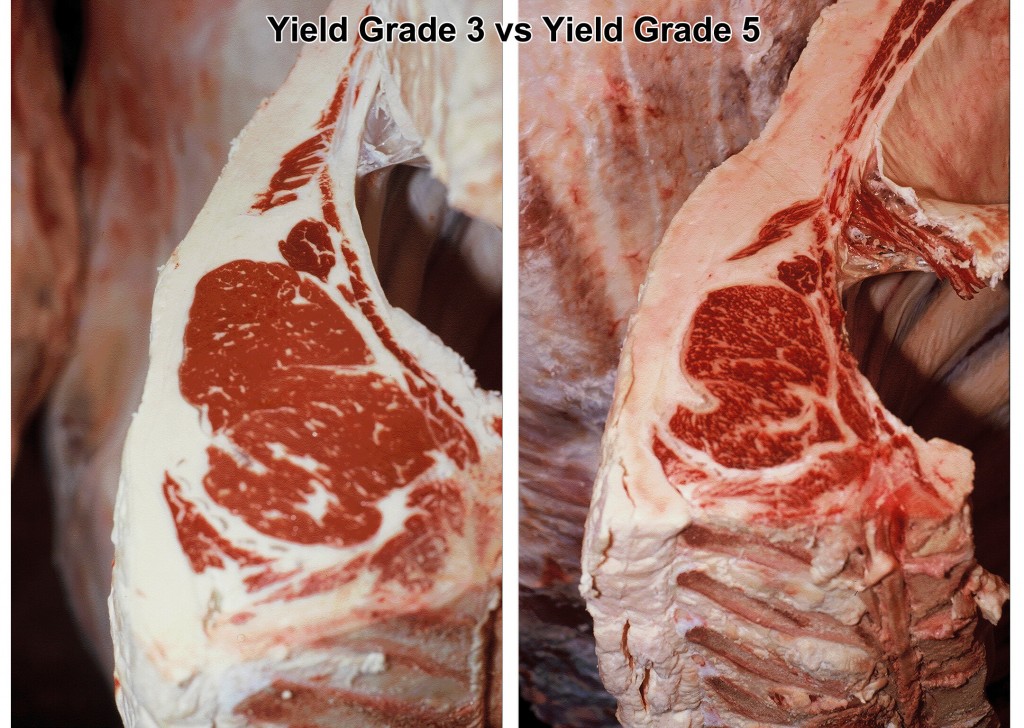
Remember how the grader gets to view the ribeye afterward it is split open? Well, not just does the grader get to view the marbling content, simply they also get to come across how large the ribeye is in foursquare inches (in relationship to its hot carcass weight), and also how much outside (subcutaneous) fat is on the carcass. They do not individually measure them, merely in today's world, the camera does that past capturing a digital image and calculating the YG.
In that location is a formula that takes into account the following when assigning a yield class. They include:
- Fat thickness at the 12th/13th rib (this is the starting indicate, or preliminary yield form, noted equally PYG). I've seen carcasses with 0.05″ and those with i.5″; but we'd await almost to fall in the range of 0.iii″ to 0.8″.
- Ribeye area in square inches (as according to the hot carcass weight). Ribeye area would typically range from 8.0 square inches (extremely modest) to 18.0 square inches (extremely large) with most in the x-sixteen square inch range. One would expect, as an animal becomes heavier, the ribeye area would be larger, up to physiological maturity, and it does follow that design. Therefore, the formula below will reflect that the heavier the carcass is, the larger the ribeye SHOULD be.
- Kidney, pelvic, and centre fat (fat that is within the body crenel, noted equally KPH and expressed every bit a percent of the hot carcass weight). The range hither would exist 1.0% up to 5%; well-nigh will be 2.5 to 3.5%. This bears the least on the formula in terms of the final yield form, but it does effigy into the final score.
Example: Let's take for instance an 800 lb carcass. Let'southward say, for kicks and giggles, it has 0.80″ of fatty encompass, and a 14.0 square inch ribeye. And, the KPH fat is three.5%.
We plug these figures into the YG formula, which is:2.5 + (2.5 * fat thickness) + (.2 * %KPH) + (.0038 * hot carcass weight) – (.32 * ribeye area)
And then: 2.5 + (2.5 * 0.eighty) +( 0.2*iii.5) + (0.0038*800) – (0.32*fourteen.0) =
(two.five + 2.0 + 0.seven + 3.04) – 4.48
8.24 – 4.48 = iii.76 yield grade (simply stamped a "YG 3").
For those of you lot who are mathemeticians, yous might guess that changing some of these figures tin can greatly touch yield class. For instance, if this had been a 725 lb carcass, what would you guess the YG might be? That'south correct, 3.475; still stamped a YG 3. But, let's take the fat down to 0.5 and at present it'south two.475, or a YG ii.
Why is this of import? In almost grid programs, YG 1 and YG two carcasses are paid a premium for them. A YG 3 is the "standard" by which Nigh grids figure every bit "par value" on carcass pricing. In other words, there are no premiums or discounts for YG iii's. But in that location are premiums for 1'due south and 2's; conversely, there are discounts for 4's and five'south. And, you guessed it, the discounts for iv's and 5's are far larger than the premiums for the 1'south and 2'due south.
They tin can be as piffling as ten bucks, but can go all the way up to $xx or $25 per cwt on the carcass weight. So that same 800 lb carcass, if it is a YG four, volition get discounted from the par value by $160. That's a pretty fair chunk of change, so you lot need to be conscientious not to go likewise many cattle also fat.
Likewise, cattle with small ribeye areas can affect yield grade. If that 800 lb carcass had a 11.5 square inch ribeye, wth that same 0.80″ of fat thickness, it's yield grade would calculate to a 4.56, or a "4". On the flip side, if information technology had a much larger ribeye area and less fat thickness, information technology (the YG) would be lower, numerically.
So, there ya become. Your primer on quality course and yield grade in beef cattle, easy as 1, two iii… or, eins, zwei, drei. I shoulda been a teacher.
Next time, I'chiliad going to talk over some new and heady DNA testing for yearling gain and marbling as a tool to use in helping select replacement heifers and screen feeder cattle. Till next time, Evict! Really, I should say, auf wiedersehen, since I'm mostly German! HA!
seymour-symerslostactunce38.blogspot.com
Source: https://cabcattle.com/yield-grades-in-beef-eins-zwei-drei/
0 Response to "How to Calculate Beef Yeild Grades"
Post a Comment